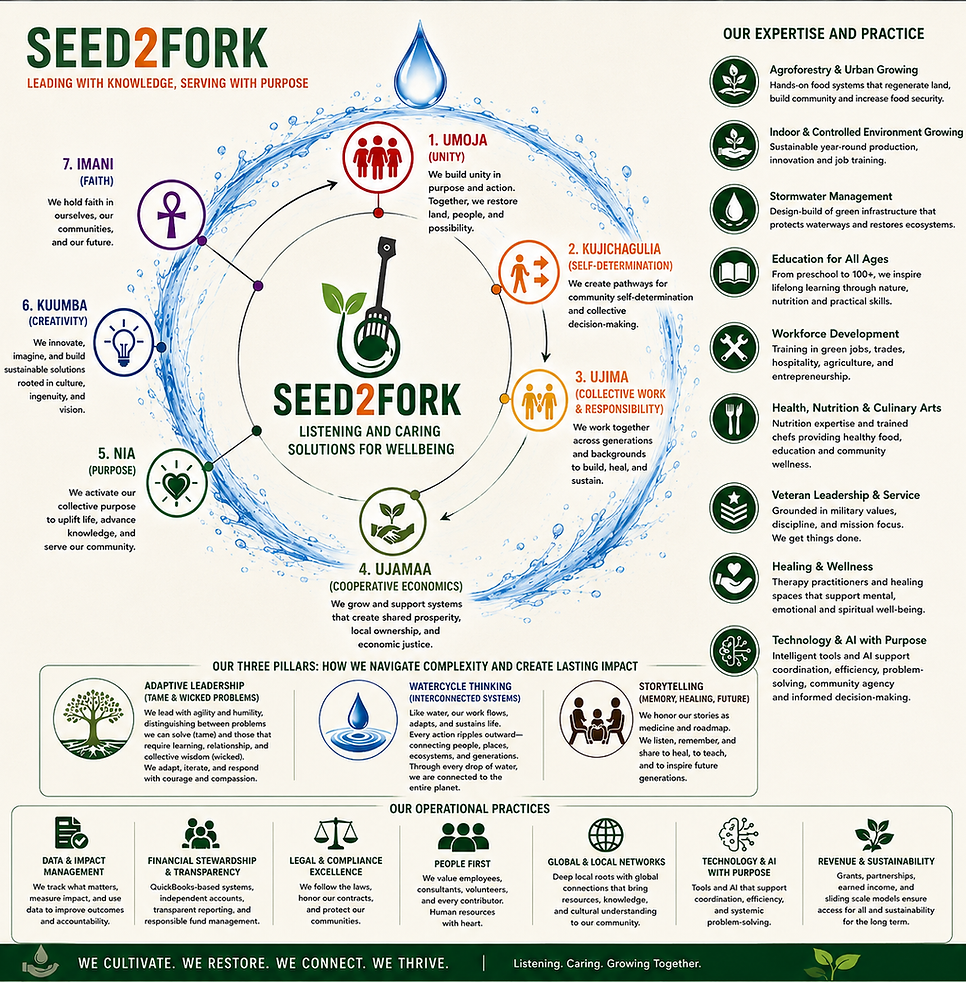
OUR AIM
As the founder and owner of Seed2Fork, I am writing to share our core aim and our unwavering commitment to advocacy and inclusivity within the agricultural sector. At Seed2Fork, we believe that advocacy for inclusivity is vital to the communities we serve. We are intentional and persistent in designing agroforestry small-farm environments where everyone feels a true sense of belonging and is empowered to contribute fully.
​
We recognize that Black farmers, along with other marginalized groups, continue to face significant systemic barriers, biases, and prejudices that hinder advancement. Our advocacy strives to amplify the voices of underrepresented individuals, promote equitable policies and practices, and cultivate inclusive cultures in every farm we design. By honoring the past and responsibly stewarding the present, we look toward the future with the ambition and inspiration necessary to drive meaningful change.
I remain deeply committed to creating healthy, multi-generational agroforestry small farms throughout Washington State that prioritize these values.
​
Thank you for your time and for your shared commitment to ensuring that advocacy and inclusion remain at the forefront of our industry.​
​​​
​
OUR FOCUS
Our focus and commitment to our mission guides our work. We are dedicated to supporting Black, Brown, Latinx, Indigenous, Native American, immigrant, and low-income communities. The individuals we serve are often treated as having “silent voices” or living in the “wrong” zip codes—factors that frequently shape the conditions and challenges we face within Washington State policies.
​​
​
OUR LANGUAGE OUR VOICE
We are sharing how we frame our work and the language we use to describe our organizational identity. We recognize that traditional agricultural and food industry terminology often fails to capture the lived experiences of the Black, Brown, Latinx, Indigenous, Native American, immigrant, refugee, and low-income communities we serve. Furthermore, we are mindful that certain forms of framing language can be harmful or reinforce systems that diminish the value and significance of these communities.
To better align with our values and our commitment to an Adaptive Leadership approach—one that honors all learning styles and diverse perspectives—we are updating our core terminology:
-
Emotional Intelligence: This term will replace “Vision” to better reflect our focus on empathy, awareness, and human-centered leadership.
-
Organizational Justice: This term will replace “Mission” to underscore our commitment to equity, accountability, and inclusion.
-
Identifying Controllable Food Models: Instead of using the term “Harmful Food Models,” we will focus on recognizing challenges while identifying the systems and models within our control to influence and improve.
​
These shifts allow us to embrace uncertainty without judgment and remain flexible as we navigate systemic challenges, including those emerging from USDA policies. As John Boyd Jr., President of the National Black Farmers Association, has noted, many of these systems were not originally designed to serve our communities equitably. By reclaiming our language, we are strengthening our collective voice and enhancing our ability to adapt and advocate within these systems.
​
We look forward to continuing this work alongside our communities through a framework that is more inclusive, representative, and rooted in justice.

OUR JOURNEY
Our journey focuses on confronting these historical disruptions, compounded by systemic issues such as institutional oppression and minority stress, which continue to contribute to significant mental and physical health crises today.
​
To combat these challenges and ensure a reliable, abundant food supply, our approach focuses on ancestral agroforestry. By cultivating trees, shrubs, herbs, and vegetables in a system that mimics a natural forest, we create a balanced ecosystem where each species supports the others. These sustainable practices have been used globally for thousands of years and are vital to restoring the health and resilience of our local communities.
​
​
OUR RESEARCH
Regarding the foundational principles of our research initiatives, our work is guided by the American Diabetes Association and the National Institutes of Health, as well as the lived experiences of the communities we serve.
​
Our approach is heavily informed by the work of leading experts like Silva A. Arslanian, a pioneer in youth-onset type 2 diabetes research and new therapies. Additionally, we are inspired by the advocacy of Joel Bervell. His work in debunking racial bias in medicine and addressing health misinformation is central to our commitment to health equity.
​
We believe that grounding our research in both clinical expertise and advocacy ensures we effectively serve our community.

We care for the Earth. We know it’s a journey and an emergent design in the communities we serve. It is a moving target shaped by the various unjust infrastructures in our neighborhoods.
.jpg)
We know caring for the people, and sharing and growing seeds, are our ancestors’ traditional methods for us to implement and achieve.

We incorporate fair share for all using methods that have been a longstanding tradition in Black, Latino, and Indigenous societies for hundreds of years when growing food.
.png)